Why Is Lord Venkateswara Called Malayappa Swamy?
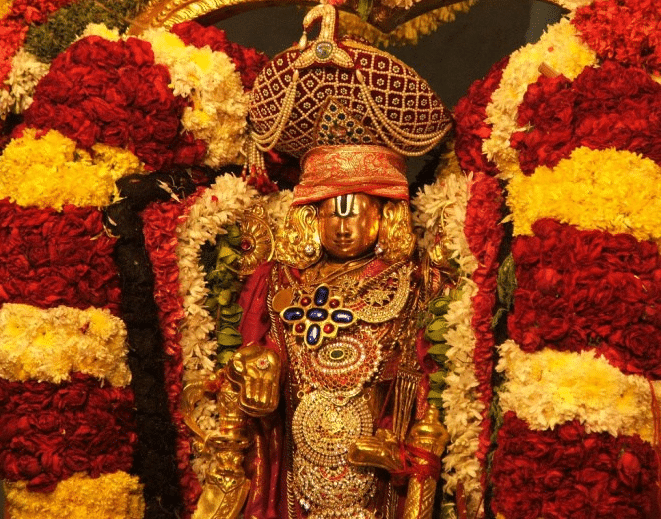
If you have visited Tirumala or read about the temple, you may have heard the name Malayappa Swamy. Many people wonder if this is a different god. He is not. Malayappa Swamy is another name and form of Lord Venkateswara (also called Balaji), the same deity worshipped in the main sanctum of the Tirumala temple.
So why does the same God have two names? Let’s understand this in simple words.
The Meaning Behind the Name “Malayappa”
The name Malayappa comes from an old title: “Malai Kuniya Ninra Perumal.” In Tamil, this means “the Lord who stood on the hill that bowed low before Him.” Over many years, this long name became shorter and shorter, until people simply called him Malayappan or Malayappa Swami.
Looking for a room in Tirupati?
Another simple way to understand the name: “Malai” means hill, and “Appa” means father. So Malayappa Swamy means “Father of the Hill” — a fitting name, since Lord Venkateswara lives on the Tirumala hills.
The Story of How Malayappa Swamy Was Found
Every temple deity has a story, and Malayappa Swamy’s story is a beautiful one.
Long ago, another idol called Ugra Srinivasa was used as the temple’s processional deity — the idol that is carried out for festivals and processions, since the main deity inside the sanctum is never moved. One day, during a procession, a sudden fire broke out in the nearby village. The people were frightened and confused about why this happened.
When prayers were offered, it is believed that God spoke through a devotee and explained that times had changed. He said a new idol, gentler and more suited for daily processions, would be found on the hill — and that idol should be used from then on.
Soon after, a new idol was discovered at a spot on the Tirumala hills where the hill is said to have bowed low in respect. This spot is still known today as Malayappan Konai (“Malayappa’s corner”). This new idol was Swayambhu — meaning it appeared on its own, not carved by human hands. Records show it was found around 1339 AD, and it has been lovingly worshipped ever since.
Why a Separate Idol Is Needed
You might ask — if Malayappa Swamy is the same as Venkateswara, why not just use the main idol for everything?
The answer lies in temple tradition. The main deity in the sanctum, called the Dhruva Bera, is fixed and never moved. It represents permanence and is meant to stay in one place forever. But temples also need to perform daily rituals like bathing, dressing, taking the deity out in processions, and celebrating festivals — activities that cannot be done with a fixed idol.
To solve this, ancient temple tradition (called the Vaikhanasa Agama) allows for five sacred forms, known as the Pancha Berams, each with a different purpose:
- Dhruva Bera – the fixed, main deity
- Kautuka Bera (Bhoga Srinivasa) – used for daily worship
- Snapana Bera (Ugra Srinivasa) – used for ritual bathing
- Bali Bera (Koluvu Srinivasa) – overseas daily temple offerings
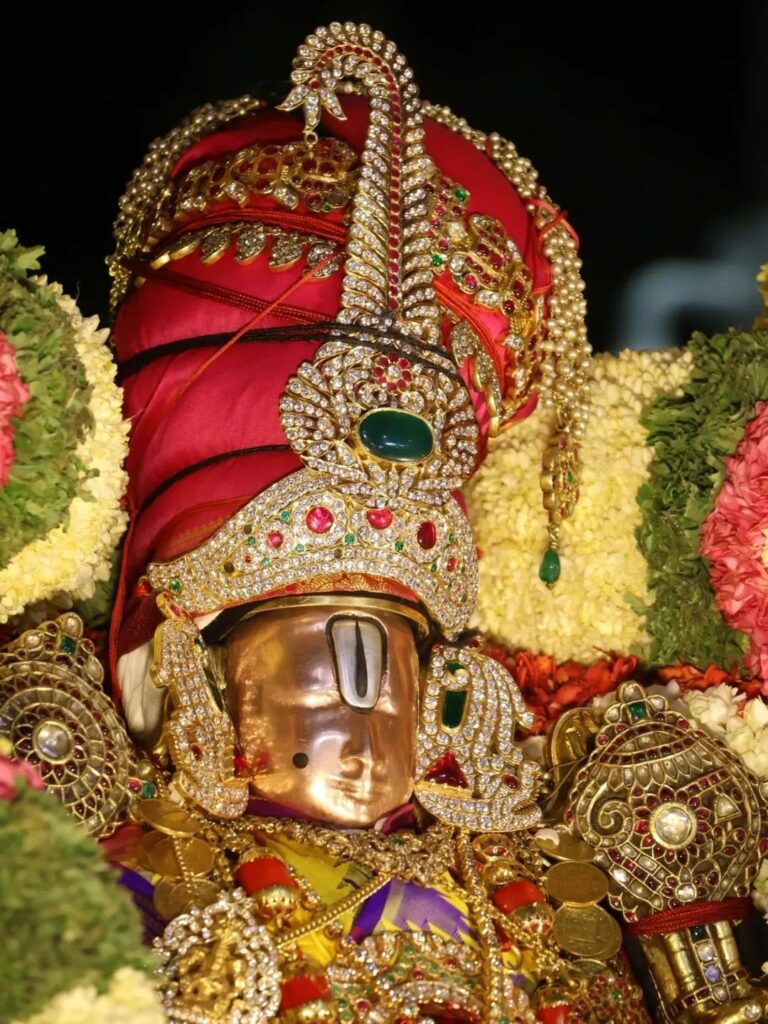
- Utsava Bera (Malayappa Swamy) – the processional deity, taken out for festivals
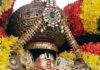
Malayappa Swamy is this fifth and most beloved form — the one devotees see during processions, festivals, and daily ceremonies outside the sanctum.
His Daily Worship and Festivals
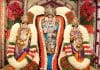
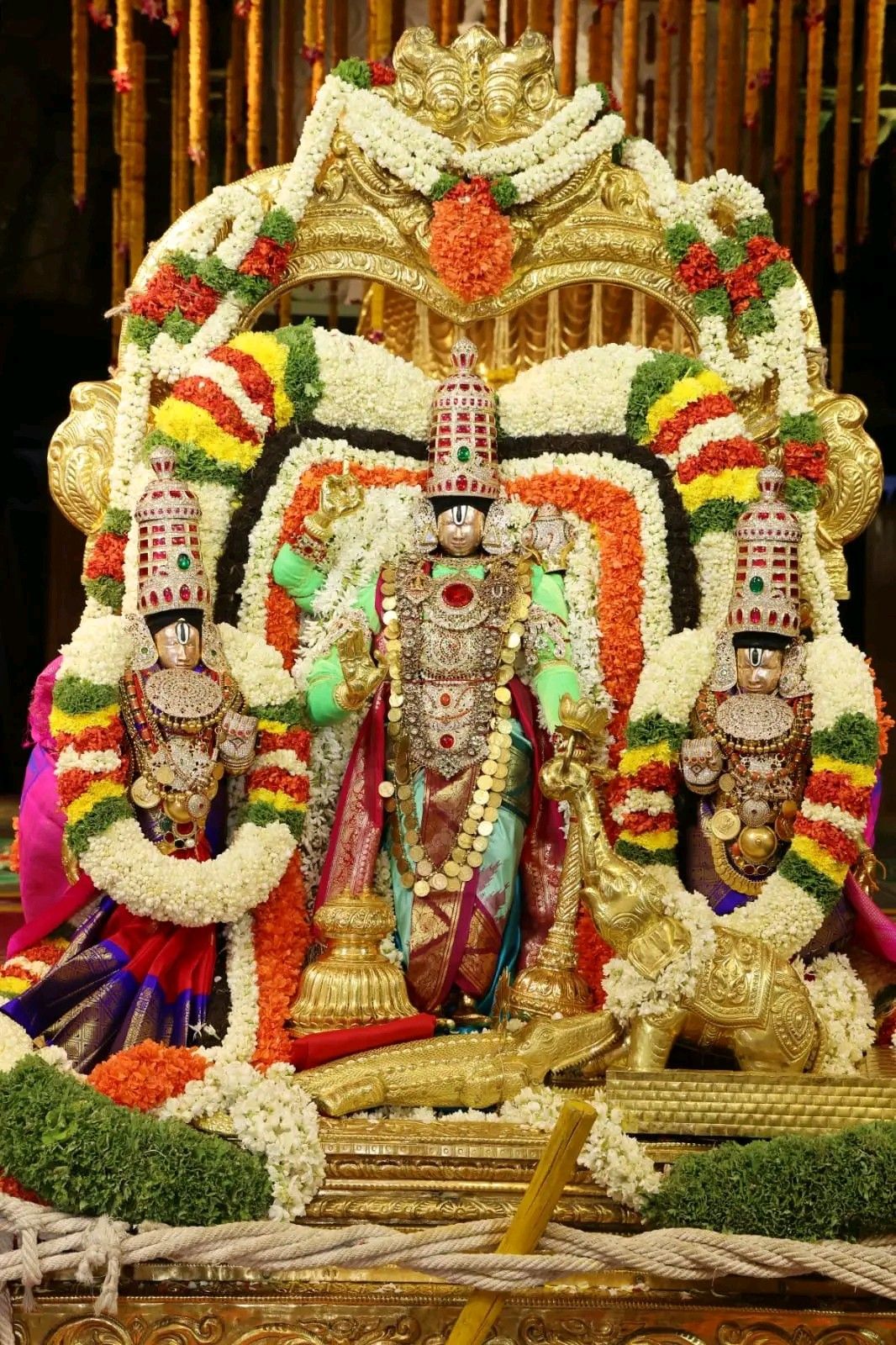
Malayappa Swamy is never alone. He is always seen with his two consorts, Sridevi and Bhudevi, standing on either side of him. Every single day, a small wedding ceremony called Srivari Kalyanotsavam is performed for him and his consorts, along with other daily rituals.
During big festivals like the famous Brahmotsavam, it is Malayappa Swamy — not the main deity — who is dressed grandly and taken around the temple streets on different vahanams (vehicles) like the elephant, horse, and golden chariot, so that thousands of devotees can have his darshan up close.
In Simple Words
Malayappa Swamy is not a separate god — he is Lord Venkateswara himself, in a movable form, created so that devotees can experience him through processions, daily rituals, and festivals. His name comes from the legend of the hill bowing before him, and his idol was found on the Tirumala hills as a divine, self-manifested form. This is why, even today, saying “Malayappa Swamy” and “Venkateswara” both mean the same beloved Lord of the Seven Hills.